

Excerpt: Junk car prices typically range from $300 to $750, depending on the vehicle’s weight, condition, and parts value. Heavier or in-demand models can sell for up to $1,500, while stripped or incomplete cars may earn closer to $100–$500.
Why Understanding Junk Car Prices Matters Before You Sell
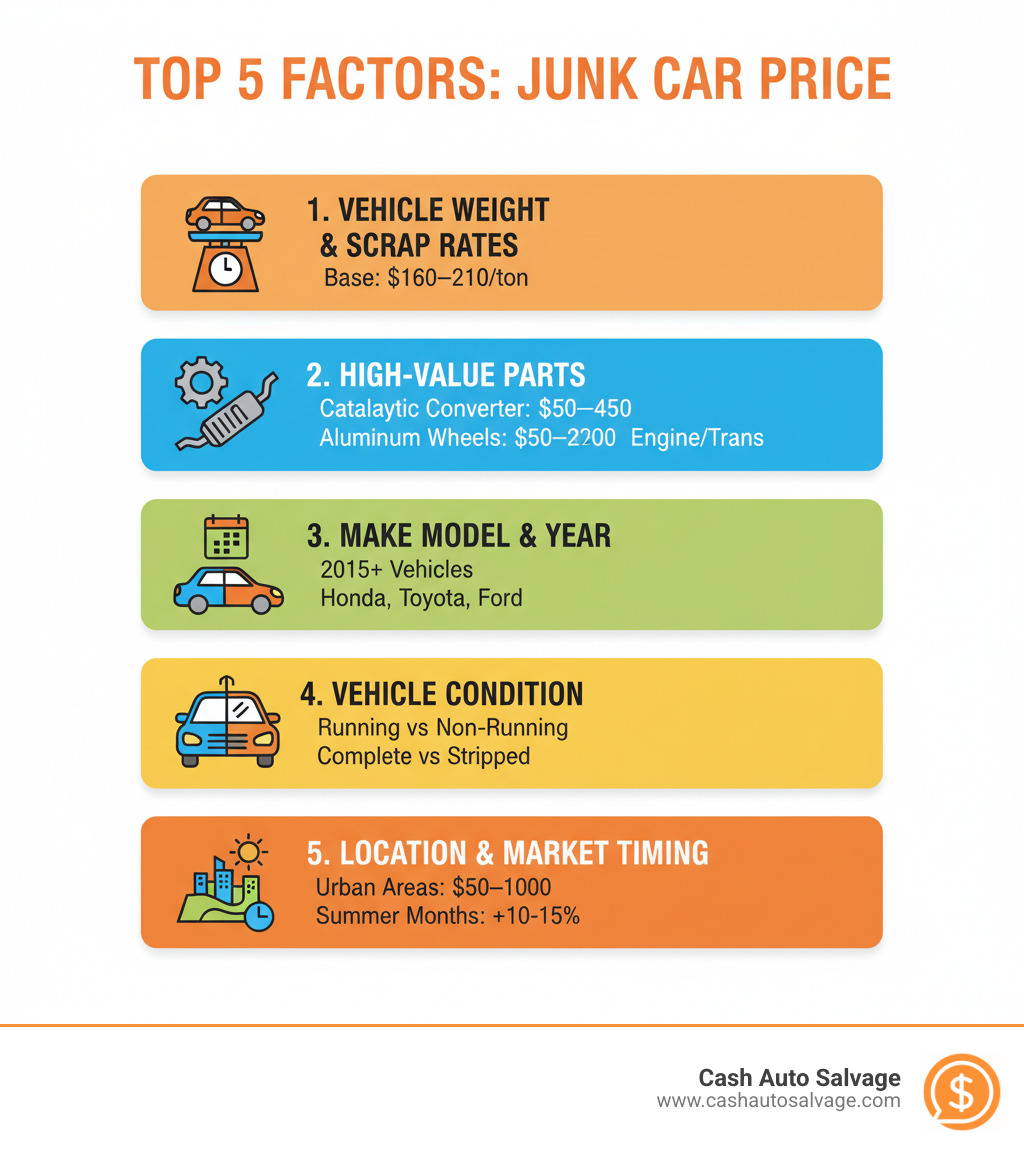
Junk cars price varies significantly based on multiple factors, but understanding the market can help you get a fair deal quickly. Here's what you need to know right now:
Quick Answer: Current Junk Car Values
- Average payout : $300 to $750 (as of January 2025)
- Recent 30-day average : $512
- Base scrap rate : $160-$210 per ton (averaging $175/ton)
- Maximum potential : Up to $1,500 for newer, heavier vehicles with valuable parts
- Non-running vehicles : Typically $100-$500
Key Factors That Determine Your Car's Worth:
- Vehicle weight (1-3.5 tons for most cars)
- Scrap metal market rates (currently $175/ton average)
- Valuable parts (catalytic converter, engine, transmission, wheels)
- Make, model, and year (2015+ vehicles fetch more)
- Condition and completeness (intact parts = higher value)
If you've been searching online for "who buys junk cars" or wondering what your old vehicle is actually worth, you're not alone. The junk car market can feel confusing, with offers ranging from $100 to over $1,000 for seemingly similar vehicles. The truth is, multiple factors influence these numbers—from the raw weight of your car's metal to whether it still has a working catalytic converter.
Maybe your car stopped running and the repair bill exceeds its value. Perhaps it's been sitting in your driveway collecting rust after a fender bender. Or you simply need the space and want quick cash without the hassle of private sales, endless tire-kickers, or expensive towing fees. Whatever your situation, knowing what drives junk cars price helps you avoid lowball offers and get paid fairly.
As Marc Skirvin, with over 12 years of experience in the auto-recycling industry at Cash Auto Salvage, I've overseen the pricing and dismantling of tens of thousands of salvage vehicles and understand exactly what determines junk cars price in today's market. This guide will break down everything you need to make an informed decision and turn that unwanted vehicle into cash today.
Understanding the Average Junk Cars Price and What Influences It
So you've got a junk car taking up space, and you're ready to turn it into cash. The big question is: what's it actually worth? You already know the average junk cars price falls between $300 and $750, with recent payouts averaging around $512. But here's what really matters—understanding why your car falls where it does in that range.
The truth is, your junk car's value comes down to a combination of raw materials and salvageable parts, all filtered through current market conditions. Let's break down exactly how buyers calculate what they're willing to pay you.
The Core Calculation: Vehicle Weight and Scrap Metal Rates
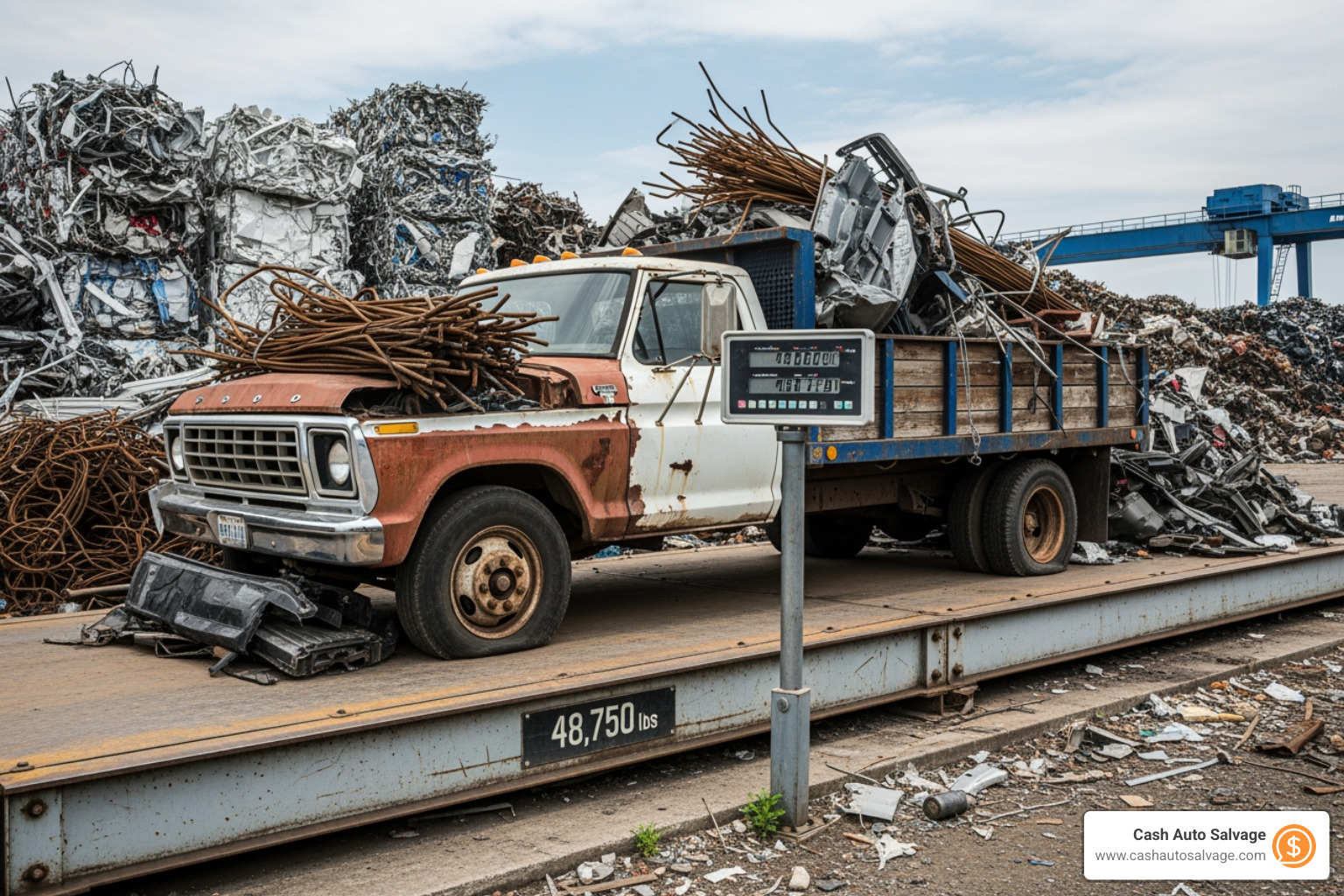
Here's the foundation of every junk car offer: weight. When you sell a junk car, you're essentially selling metal by the ton. Most vehicles are made up of 55–65% steel, which means steel prices directly impact what you'll receive. Right now, scrap car prices range from $160 to $210 per ton , with the current average sitting at $175 per ton.
This is why a heavier vehicle almost always means more money in your pocket. A compact sedan simply doesn't have the same metal content as a full-size truck, and that difference shows up in the offer.
To help you understand what your specific vehicle type might be worth based purely on weight, here's a breakdown using today's average scrap rate of $175 per ton:
| Vehicle Type | Estimated Weight (lbs) | Estimated Weight (tons) | Estimated Scrap Value ($175/ton) |
|---|---|---|---|
| Compact Car | 2,000 – 2,750 | 1.0 – 1.375 | $175 – $240.63 |
| Midsize Sedan | 3,000 – 3,750 | 1.5 – 1.875 | $262.50 – $328.13 |
| SUV | 4,000 – 4,800 | 2.0 – 2.4 | $350 – $420 |
| Truck | 5,000 – 7,000+ | 2.5 – 3.5+ | $437.50 – $612.50+ |
Note: These numbers represent the base scrap metal value only. Your actual payout will likely be higher once we factor in the valuable components still attached to your vehicle.
Think of this as your starting point—the absolute minimum your car is worth as raw material. But most junk cars are worth considerably more than just their weight in steel, which brings us to the real money-makers.
Beyond the Scale: High-Value Parts That Boost Your Offer
Your junk car isn't just a pile of metal—it's full of components that are worth far more than their weight. These salvageable parts can dramatically increase your payout, sometimes doubling or even tripling the base scrap value.
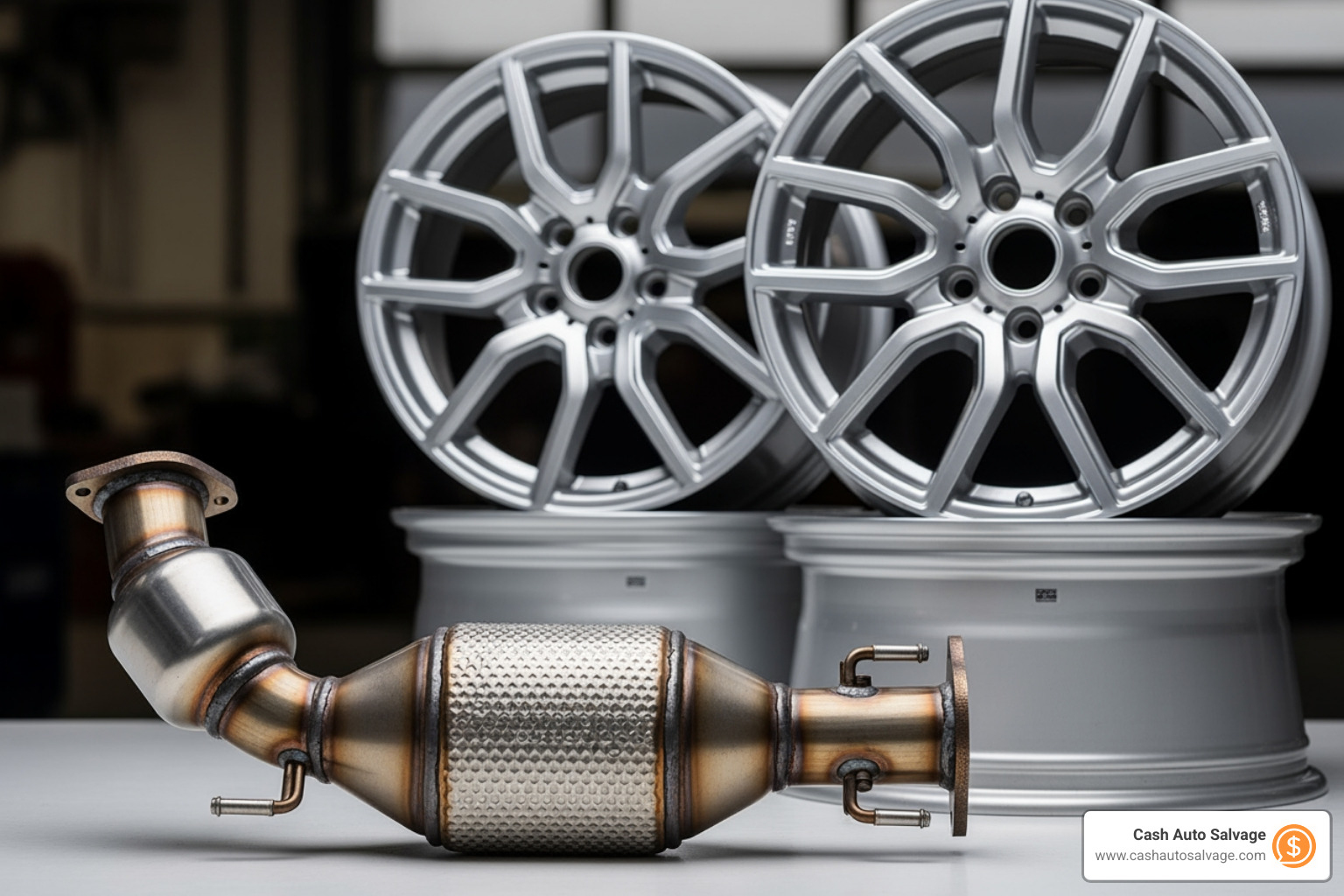
The star of the show? Your catalytic converter. This unassuming component contains precious metals like platinum, palladium, and rhodium, making it incredibly valuable. A working catalytic converter can add anywhere from $50 to $450 to your junk cars price. This is exactly why you'll see a significant reduction in your offer if it's missing—sometimes hundreds of dollars less.
But the catalytic converter isn't the only valuable component hiding under your hood. Your engine and transmission can add substantial value if they're intact and in usable condition. These major components can often be reconditioned and resold, making them worth far more than their scrap weight.
Those aluminum wheels you've been rolling on? They're worth considerably more per pound than standard steel wheels. A full set of four aluminum rims, weighing around 60-80 pounds total, can boost your offer by $50 to $200. Even your copper radiator adds value—with 10-20 pounds of pure copper inside, it's worth an additional $40 to $80.
Don't overlook the smaller components either. Your car's battery has a lead core that's worth $10 to $20 , and the copper wire harness running throughout your vehicle can add another $20 to $40 to your payout.
Here's a real-world example that shows how these parts transform your offer: Imagine you have a 2-ton vehicle. Based purely on weight at $175 per ton, that's a base value of $350. Now add a catalytic converter worth $100 and aluminum wheels worth $150. Suddenly, your total estimated value jumps to $600—nearly double the base scrap value!
On the flip side, if your car is missing key components like the engine or transmission, expect your offer to drop by $100 to $500. A stripped car shell with only the frame and body remaining typically fetches just $100 to $300 because it's valued purely on weight with none of these valuable extras.
The Influence of Make, Model, Year, and Condition
Not all junk cars are valued equally, and this is where your vehicle's identity really matters. The year, make, and model of your car significantly impact what buyers are willing to pay.
Newer vehicles , especially those from 2015 or later , consistently fetch higher prices. Why? They contain more modern components that are still in demand. Their parts are more likely to fit newer vehicles on the road today, making them easier to resell. A 2018 Honda Accord will command a better price than a 1998 model, even if both are headed to the salvage yard.
Popular brands like Honda, Toyota, and Ford also receive higher offers. These manufacturers have millions of vehicles on the road, which means constant demand for their parts. When salvage yards know they can easily sell components from these vehicles, they're willing to pay more upfront.
Now, when it comes to condition, there's an interesting nuance. For pure scrap value based on weight, condition doesn't matter much—steel is steel. But for a junk car that still has usable parts, condition becomes crucial.
A running vehicle , even one with significant problems, typically commands a better price than a completely dead car. If your car can still start and move under its own power, it's easier to transport and signals that major components might still be functional. Non-running vehicles generally sell for $100 to $500 , depending on weight and salvageable parts.
Completeness is another key factor. A complete car with its engine, transmission, wheels, doors, and catalytic converter all present is worth more than one missing major components. If your vehicle has been stripped or is missing the engine or transmission, expect offers to drop by $50 to $250 or more.
The extent of damage also matters, though perhaps not how you'd expect. While a "totaled" vehicle (where repair costs exceed the car's value) is certainly a junk car, buyers still assess the type and severity of damage. A car totaled from a collision might still have plenty of usable parts. However, vehicles with flood damage or fire damage are typically not accepted by Cash Auto Salvage and many other buyers due to safety concerns and contamination issues that make the parts unusable.
Understanding these factors gives you realistic expectations and helps you recognize a fair offer when you see one. Your junk cars price isn't random—it's a calculated value based on these specific elements working together.
Navigating the Market: Why Junk Car Prices Fluctuate
The market for junk cars isn't static; it's a dynamic environment where prices can shift as frequently as the weather. Understanding these fluctuations is key to getting the best possible junk cars price for your vehicle.
Decoding Market Dynamics: From Global Demand to Local Supply
Scrap car prices are tied directly to the global market for raw materials like steel, aluminum, and copper. These commodity prices are influenced by a complex web of factors:
- Global Demand : Industrial growth, especially in manufacturing and construction sectors worldwide, drives demand for metals. When factories are humming, metal prices tend to rise.
- Economic Cycles : During periods of economic growth, demand for new products increases, which in turn boosts the demand for raw materials and thus scrap metal prices. Conversely, economic slowdowns can depress prices.
- Trade Activity : International trade policies, tariffs, and shipping costs can all impact the profitability of moving and processing scrap metal, affecting prices.
- Local Supply : If there's a surplus of junk cars in a particular area, local scrap yards might lower their offers due to an abundance of supply. Conversely, low local supply can lead to higher competitive offers.
These factors combine to create a constantly shifting landscape. We've seen that scrap car prices can fluctuate weekly, with shifts of 3–7%, and monthly changes can be as significant as up to 20%. This volatility means that the price you get today could be different next week.
How Location and Seasonality Affect Your Payout
Where you're located and even the time of year can significantly impact the junk cars price you receive.
- Geographic Differences : Location is paramount. Urban areas and industrial states often pay more for junk cars due to higher competition among buyers and closer proximity to steel mills and processing facilities. For instance, industrial states can pay 15-25% higher scrap prices than rural states, thanks to reduced transport costs and greater demand. Our extensive network across Alabama, California, Florida, Illinois, Michigan, New York, Ohio, Texas, and many more states within the U.S. means we understand these local market nuances and can offer competitive prices.
- Seasonal Demand : Believe it or not, there's a "best" time of year to sell your junk car. Summer months, typically between May and August, tend to see higher prices. This is often due to increased construction and manufacturing activity, which drives up the demand for steel and other metals. Historically, scrap values are 10–15% higher during these months compared to winter. So, if you can hold onto your junk car until summer, you might just get a fatter wallet!
A Seller's Playbook: How to Maximize Your Payout
You've learned what drives junk cars price and how the market works. Now comes the fun part—actually getting top dollar for your vehicle. With a bit of preparation and smart negotiating, you can squeeze every last penny out of that old clunker.
Preparing for a Smooth and Profitable Sale
Before you call for a quote, spend 30 minutes getting your ducks in a row. This small investment of time can prevent headaches later and might even boost your payout.
The single most important item you need is your vehicle title. This little piece of paper proves you own the car and have the legal right to sell it. Most buyers, including Cash Auto Salvage, strongly prefer (and sometimes require) a clean title to complete the transaction. Without it, the process gets complicated, and some buyers might reduce their offer or walk away entirely. If you've misplaced your title, contact your local DMV about getting a duplicate—it's usually worth the $20-$30 fee. In some states and situations, alternative proof of ownership like registration documents might work, but having the title is always your best bet.
Next, do a thorough sweep of your car for personal items. Check under the seats, in the glove compartment, the trunk, that weird little pocket in the door—everywhere. I've heard stories of people losing family photos, expensive sunglasses, and even cash they'd forgotten about. Once that tow truck hauls your car away, those items are gone for good.
Don't forget to remove your license plates before the pickup. Most states require you to either return them to the DMV or transfer them to your new vehicle. Leaving them on can lead to annoying complications down the road, like getting tickets for a car you no longer own.
How to Get the Best Junk Cars Price Through Negotiation
Here's where you put on your business hat and make sure you're getting a fair shake. The secret weapon? Information and competition.
Getting multiple quotes is the single most powerful thing you can do. Think of it like shopping for a new TV—you wouldn't buy the first one you see without checking other stores, right? Same principle here. Reach out to at least three to five different buyers. This gives you a realistic picture of your car's market value and creates leverage for negotiation. When you tell one buyer, "I've got an offer for $500 elsewhere," they suddenly become more flexible.
When comparing offers , look at the whole package, not just the number. One buyer might offer $450 with free towing, while another offers $475 but charges $75 for pickup. Guess which one actually puts more money in your pocket? The first one. At Cash Auto Salvage, we include free towing with every offer, so the price we quote is the cash you receive—no surprise deductions at the last minute.
Armed with multiple quotes, you're ready to negotiate. Be honest about your vehicle's condition, but don't be shy about highlighting valuable components. Got a newer battery? Mention it. Still have all four aluminum wheels? That matters. If one buyer offers less than others, simply ask if they can match the higher offer. The worst they can say is no, and you've lost nothing.
One insider tip: verifying your vehicle's weight can help you spot lowball offers. Most owner's manuals list the curb weight, or you can find it with a quick online search. If you know your midsize sedan weighs about 3,500 pounds (1.75 tons) and current scrap rates are $175 per ton, you can quickly calculate a baseline value of about $306 for metal alone—before considering parts. An offer significantly below this baseline is probably too low.
The bottom line? Do your homework, get multiple quotes, and don't be afraid to negotiate. Your old car might be junk, but that doesn't mean you should accept junk offers. With these strategies, you'll walk away with cash in hand and the satisfaction of knowing you got a fair deal.
Frequently Asked Questions About Junk Car Value
Selling a junk car often raises questions, especially when you're trying to figure out if the offer you're getting is fair. Here are some of the most common questions we hear from sellers, with straightforward answers to help you understand what your vehicle is really worth.
What is a stripped car shell worth?
If your car has been stripped down to just the frame and body panels, you're essentially left with a metal shell. Without the engine, transmission, catalytic converter, or any of those valuable components we talked about earlier, the junk cars price drops significantly. You're now looking at pure scrap metal value—nothing more, nothing less.
A stripped shell is valued solely on its weight and whatever the current scrap metal rates happen to be. With rates hovering between $160 and $210 per ton (as of August 2025), most stripped shells will fetch between $100 and $300. A compact car shell on the lighter end might bring $100 to $150, while a heavier SUV or truck frame could reach $250 to $300. It's not much, but it's still cash for something taking up space in your driveway.
How are electric and hybrid junk cars valued?
Electric and hybrid vehicles are a different breed when it comes to junk car valuation. The good news? They often command higher prices—sometimes 30% to 50% more than traditional gas-powered vehicles of similar weight. This premium comes from their unique components.
These vehicles contain lithium-ion batteries, which have significant recyclable value. They also pack more copper wiring and other non-ferrous metals than conventional cars, and these materials are worth more per pound than standard steel. A hybrid's battery pack alone can add hundreds of dollars to your offer.
However, there's a catch. Electric and hybrid vehicles require specialized recycling processes, particularly for those high-voltage batteries. Not every scrap yard has the equipment or expertise to handle them safely. Some buyers simply won't accept them at all. At Cash Auto Salvage, we're equipped to handle these modern vehicles and provide competitive offers that reflect their true value, including those premium components.
What's the difference between "scrap value" and "junk car value"?
This distinction trips up a lot of sellers, but it's actually pretty straightforward once you break it down.
"Scrap value" is the baseline price—what you'd get if your car were simply crushed into a cube and melted down for its raw metals. It's calculated by weighing your vehicle and multiplying that weight by the current price per ton for steel, aluminum, and copper. This is the floor price, the absolute minimum your car is worth based purely on its metal content.
"Junk car value" is the bigger picture. It includes that scrap value plus the worth of any parts that can be salvaged, reused, or resold. We're talking about engines that can be rebuilt, transmissions that still shift smoothly, catalytic converters with precious metals, aluminum wheels, copper radiators, and countless other components. A complete car with these valuable parts intact can be worth two or three times its scrap value alone.
Think of it this way: scrap value is like selling your house for the lumber and nails, while junk car value is recognizing that the plumbing, electrical system, and appliances all have worth too. When you get a quote for your junk car, you're ideally getting the full junk car value—not just the scrap value. That's why a complete vehicle in decent shape will always fetch more than a stripped shell, even if they weigh the same.
Conclusion: Turn Your Junk Car into Cash Today
You've made it through the maze of junk cars price factors, and honestly, you're now ahead of most sellers out there. What might have seemed like a confusing jumble of numbers and market forces at the start should now make sense. Your vehicle's worth isn't some arbitrary figure a buyer pulls out of thin air—it's a calculation based on weight, salvageable parts like that precious catalytic converter, the make and model, current market conditions, and even where you live and when you sell.
The key takeaways? Your junk car's value depends primarily on its weight and the current scrap metal rates, but high-value parts can significantly boost your payout beyond the base scrap value. Market conditions fluctuate, sometimes dramatically, so timing matters. And perhaps most importantly, you don't have to accept the first lowball offer that comes your way.
You're now equipped to get a fair price. You know what questions to ask, what paperwork to have ready, and why getting multiple quotes is so important. You understand that free towing isn't just a nice perk—protecting your bottom line. And you know that a complete car with intact parts will always fetch more than a stripped shell.
At Cash Auto Salvage, we've built our entire business around making this process as painless as possible for you. We understand that selling a junk car can feel overwhelming, which is why we offer instant cash offers in just 90 seconds for your junk car, truck, or SUV—no matter what condition it's in. Gently used? Great. Completely totaled? We'll take it. We handle all the paperwork headaches, provide free towing so you keep every dollar we quote, and ensure fast payment because we know you've got better things to do than wait around.
That old car sitting in your driveway or garage isn't doing you any favors. It's taking up space you could use for something better, and every day you wait is another day you're not holding cash in your hand. Ready to see what your vehicle is actually worth? Get an instant estimate of your car's salvage value and find how much cash you could have today.